
Be There
Blog
Slack team building activities: rituals your team will actually join
By BeThere
Aug 16, 2026 • 16 min read
Share this post


Most Slack team building activities die the same way: someone drops a Zoom link, half the team is in another meeting, and the three people who join spend ten minutes waiting for a fourth. The problem is not the activity. It is the venue. Team building that asks people to leave Slack — the place they already work — is an extra event on an extra calendar, with an extra login.
This guide is for teams that already live in Slack and want rituals people will actually join. The activities below run inside the workspace: in a channel, a thread, a huddle, or a poll. Most of them are async. A few are live. All of them include the part most round-ups skip — how you set them up, how you get a real headcount, and how you keep them alive past week three.
The tool everyone is already in beats the tool everyone has to be invited to.
Why Slack is where team building actually happens
Distributed and hybrid teams do not lack ideas. They lack a place where an idea can become a habit without a project manager attached to it. Slack is already that place for work. It can be that place for the social layer too, if you treat channels as rooms rather than dumping grounds.
✦The invite nobody accepts
A calendar invite for “virtual coffee, optional” competes with stand-ups, focus time, and school pickup. Optional social events lose to anything with a ticket number. When the same coffee is a 20-minute huddle posted in #team-social with a Join button, the cost of showing up drops: no new tab, no new tool, no camera-on pressure unless you want it.
That is the test for every activity in this article. If joining it requires leaving Slack, expect the same no-show rate you already have. If joining it is a reply, a reaction, or a huddle in a channel the team already reads, participation becomes a side effect of the workday rather than a separate appointment.
✦Async is a feature, not a consolation prize
Synchronous team building assumes a shared lunch hour. Most distributed teams do not have one. An async ritual — a Friday wins thread, a photo of the week, a prompt that sits in a channel for 24 hours — lets people join at 08:00 in Lisbon and 16:00 in Singapore. The thread is the event. Nobody is late.
Async also lowers social risk. A quiet engineer who will never unmute in a 30-person Zoom will drop a photo and a sentence in a thread. That is still team building. It is often the only kind that reaches the whole team rather than the extroverts who would have gone to the pub anyway.
✦Start from a channel you already have
Do not create #fun and hope. Rituals stick in channels people already open: the team channel, the office channel, the one that already has a weekly rhythm. If you need a dedicated space, pick one name, pin a short “how we use this” message, and give it two weeks of actual posts before you invent a second channel.
A workable default:
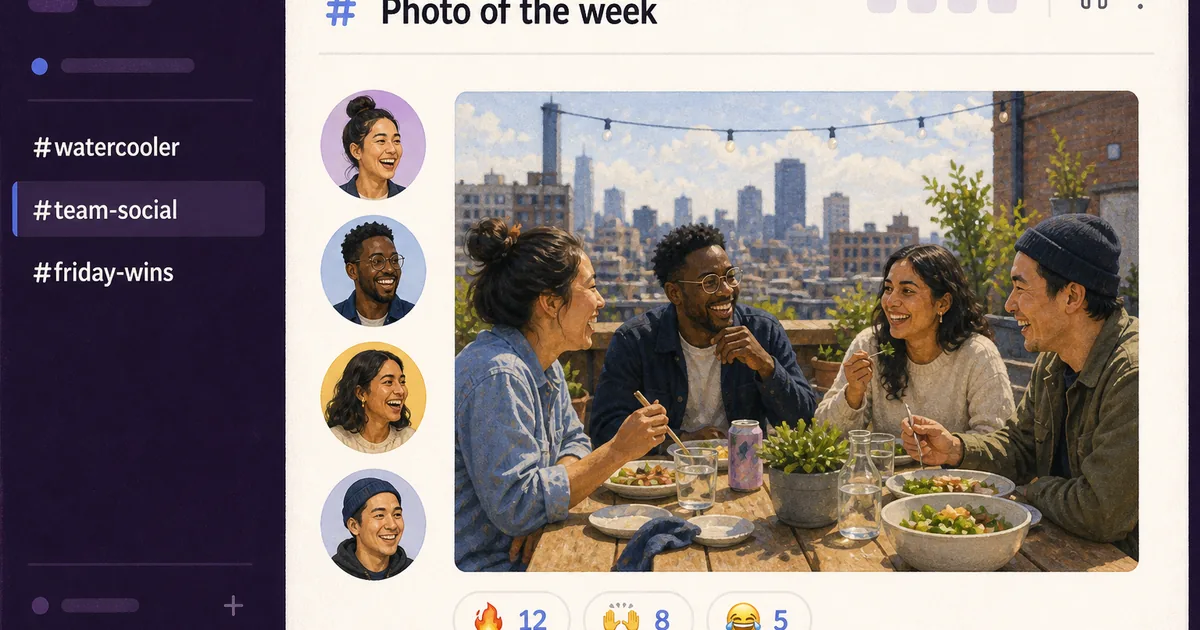
- #watercooler — daily or thrice-weekly prompts, pictures, low-stakes chat.
- #team-social — events, huddles, anything with a time attached.
- #friday-wins — one thread a week. Archive it if it goes quiet; do not let it rot.
Three channels is plenty. One is enough for a team under 20.
Async rituals that run themselves
The best Slack team building activities are boring on purpose. They run on a cadence, they take under two minutes to join, and they do not depend on one charismatic organiser being online. Set them up once. Rotate who posts. Kill them if the thread is empty two weeks in a row.
✦The #watercooler prompt
A single question, posted at the same time each day or three times a week, in a thread so the channel stays readable. Examples that actually get replies: “What is on your desk that is not a laptop?”, “A tool you refuse to give up”, “The last thing you cooked”, “A local recommendation for someone visiting your city”.
Setup:
- Write 20 prompts in a doc so you are never inventing them at 09:00.
- Post as a thread starter, not a channel-flooding message. Ask people to reply in-thread.
- React to the first three replies yourself. Empty threads stay empty; a couple of visible replies give everyone else permission.
- After two weeks, look at which prompts got replies and drop the rest.
✦Friday wins thread
Every Friday morning, one message: “What did you ship, finish, or survive this week?” People reply in the thread. Managers who want a pulse on morale read it; they do not demand it in the 1:1. Keep it optional and specific — “wins” that have to be professional metrics will dry up. A win can be “the build went green” or “I finally took a lunch break”.
Setup: same poster, same time, same wording, every week. Put it on a recurring calendar reminder for whoever owns it this month. Pin the latest thread. Unpin last week’s.
✦Photo of the week
One prompt, one photo per person, posted in a thread. Themes that work: the view from where you work, a lunch, a pet crashing a call, a building you walked past. People react with emoji; the organiser does not need to crown a winner. If you want a winner, use a reaction as the vote and close it on Friday.
This is the ritual that scales to mixed office/remote teams. The office crowd posts the rooftop; the remote crowd posts the kitchen window. The channel becomes a place you glance at, not a meeting you attend.
✦Emoji-reaction polls
Polls are the smallest possible team activity and the one people will actually complete. Use them to pick a lunch spot, a date, a theme, or a silly binary (“team pineapple on pizza”). The point is a visible, low-effort decision in the channel — not a spreadsheet of votes that someone has to tally after the fact.
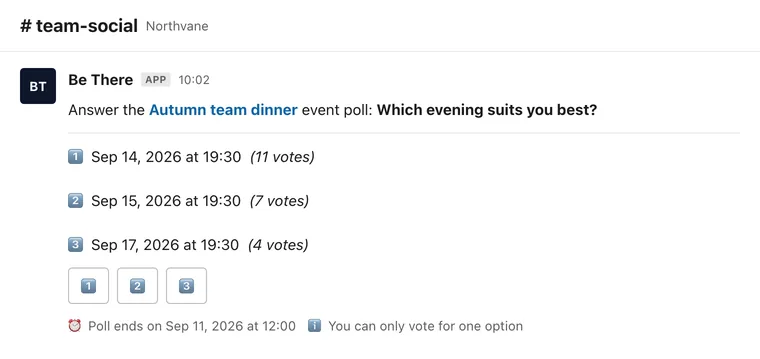
Setup:
- Ask one question. Three options is plenty.
- Show the running tally in the same message so people can see they are not voting into a void.
- Put a close time on it. An open-ended poll is not a decision; it is decoration.
- Post the result in the same thread and, if it was picking a date, turn that date into an event the same day. A poll that does not become a plan trains people to ignore the next one.
✦Donut-style pairings
Random pairs (or trios) every week or every two weeks, posted in a channel or as a DM. The pairing is the whole ritual: “You two have 20 minutes this week. Huddle, walk, or async thread — your choice.” Do not attach a mandatory agenda. Do not require a write-up afterwards. If you want a light prompt, offer one optional question and let people ignore it.
Setup: a spreadsheet of names and a weekly reminder is enough for a team under 30. For larger teams, use a pairing app in Slack if you already have one; do not add a second tool just for this. Skip anyone who opts out, and skip people who are out that week. Forced pairing is not team building.
Live activities that stay in the workspace
Live still has a place. The constraint is the same: stay in Slack. A huddle in the channel beats a Zoom with a waiting room. A trivia round in a thread beats a Kahoot that needs a code. If the activity cannot survive a dropped video tile, it does not belong here.
✦Huddle games that do not need a Zoom link
Slack huddles are good for 4–12 people and 15–20 minutes. Games that work: two truths and a lie, “what am I drawing” over a shared screen, a 10-question quiz the host reads out, a show-and-tell from whatever is within reach. Games that do not: anything that needs breakout rooms, a separate board, or more than one host.
Setup: announce the huddle in the channel 24 hours ahead with a start time in UTC and in the two time zones you actually have. Start on time even if two people are missing. End on time even if it is going well. Overrunning is how optional huddles become another meeting people dodge.
✦In-thread trivia
The host posts a question; answers go in a thread; the host posts the answer after a set time (10 minutes, or until end of day for async trivia). Keep rounds to five questions. Themes the team already cares about land better than generic pub-quiz bags: your product, your city, last quarter’s inside jokes, a customer’s industry.
Score with reactions, not a spreadsheet. A :white_check_mark: on a correct reply is enough. Publish a running total in the thread starter if you must have a winner; most teams will play without one.
✦Guess the photo
Someone posts a tightly cropped photo — a desk corner, a street sign, a lunch, a pair of shoes — and the channel guesses whose it is or where it is. Reveal at the end of the day. This is the rare live-feeling activity that is fully async, so it works across time zones.
Setup: one host, one photo a day for a week, or one a week for a month. Collect photos ahead of time in a DM so you are not chasing people at 09:00. If you run this after an in-person event, use the pictures people already took that day rather than asking for a new photoshoot.
✦Virtual coffee, with a container
“We should do virtual coffees” is not an activity. A container is: a 15-minute huddle, a posted pair, a start time, and a posted end. Put three slots on a thread (“10:00, 14:00, 16:00 UTC — react to join one”) and run whichever slot gets at least two people. Cancel the empty ones in public so the channel sees that empty slots die rather than lingering as guilt.
A quick map of what to pick:
| Activity | Team size | Effort to run | Sync or async |
|---|---|---|---|
| Watercooler prompt | Any | 5 min to post | Async |
| Friday wins thread | Any | 5 min to post | Async |
| Photo of the week | Any | 10 min to host | Async |
| Emoji-reaction poll | Any | 5 min | Async |
| Donut-style pairing | 8–80 | 15 min a week | Async, optional huddle |
| Huddle game | 4–12 | 20 min live | Sync |
| In-thread trivia | 6–40 | 20–40 min | Either |
| Guess the photo | Any | 10 min to host | Async |
| Virtual coffee slot | 2–6 per slot | 15 min live | Sync |
If an activity needs a new login, a new tab, and a new time zone negotiation, it is not a Slack team building activity. It is another meeting.
The part everyone skips: turning an activity into an actual event
A prompt in a channel is a ritual. A dinner, a huddle game, a volunteer afternoon, a welcome breakfast — those are events. Events fail in the gap between “sounds fun” and a room with a headcount. Slack can close that gap if you stop treating RSVPs as emoji on a message that scrolled away.
✦Announcement where the team already is
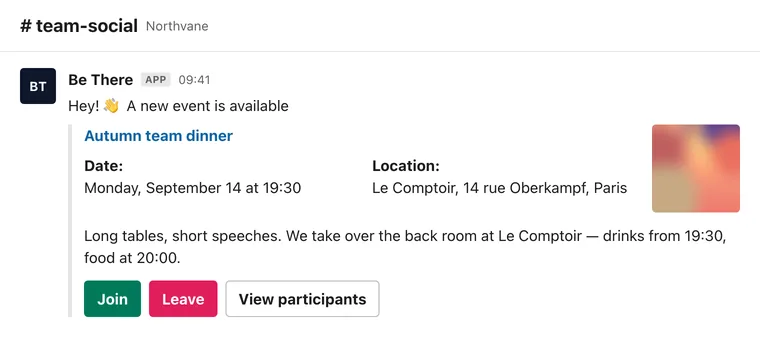
Post the event in the channel the team already reads, not in a side channel created for the occasion. Include the three facts people need to decide: what, when (with a timezone), and how to say yes. If there is a capacity — a table of eight, a room of twenty — say so in the same message. People cannot guess a headcount you have not published.
✦RSVP, reminders, and a real headcount
Emoji RSVPs look busy and count badly. People add a reaction and forget; people leave and do not remove it; nobody wants to be the person who asks “so is this happening?”. A yes that is a button, a visible participant list, and a reminder a day or two before is the difference between 14 yeses and 6 chairs filled.
This is the one place a dedicated mechanic helps. Be There runs that loop in Slack: the announcement lands in the channel, people join or leave in one click, the headcount is visible, a reminder goes out before the date, and photos come back to the same channel afterwards. You can approximate the same loop by hand — a pinned post, a spreadsheet, a calendar hold, a reminder you set yourself — and for a one-off that is fine. For a monthly ritual, the manual version is how events quietly stop happening.
A working checklist, with or without a tool:
- Announce at least five working days ahead for anything that needs a room, a booking, or travel. Two days is enough for a 20-minute huddle.
- Close RSVPs when you need a number (catering, a table, a headcount at the door). Say the close time in the announcement.
- Send one reminder, not four. The day before, in the same channel, with the current headcount.
- After the event, post a recap in the same thread: who came, one photo, a date for the next one while the energy is still there.
✦Photos back in the same channel
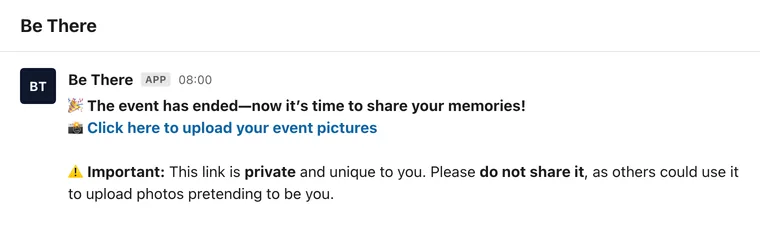
The follow-up is part of the event. A photo in the thread is social proof for the people who skipped this one and a memory for the people who came. It also gives the next announcement something to point at besides a blank description. Collect pictures the same day. Do not start a new album in another app and forget to share it.
Making rituals stick past week three
Week one is enthusiasm. Week two is habit-forming. Week three is where most Slack team building activities go to die because the original poster is on leave and nobody else thinks it is theirs. Stickiness is an operations problem, not a creativity problem.
✦Cadence beats novelty
Pick a rhythm and keep the format stable. Friday wins every Friday. A photo prompt every Monday. A huddle game on the first Wednesday of the month. Novelty is for the content (a new prompt, a new theme), not for the container. People join things they can predict. They skip things they have to decode.
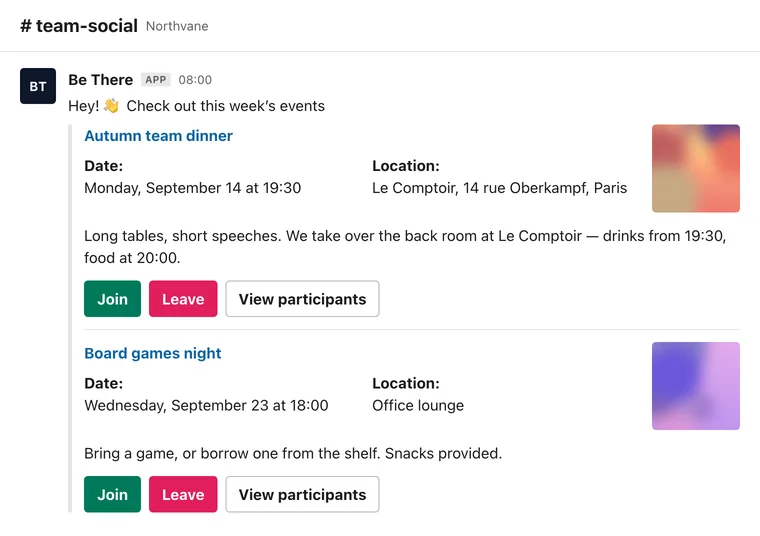
A weekly digest of what is on — even a short list posted every Monday — does more for attendance than a clever new game. It is the ritual that reminds people the other rituals exist.
✦Rotate ownership
Put a name next to every ritual, and rotate it monthly. The job is small on purpose: post the prompt, start the huddle, close the poll. Write the job in the pinned message so a substitute can do it without a handover call. If only one person has ever run trivia, you do not have a ritual. You have a hobby.
✦Kill what nobody joins
Empty threads train the team to ignore the channel. If a ritual gets fewer than three genuine replies two weeks in a row, end it in public: “We are stopping photo of the week — not enough takers. Friday wins stays.” That sentence is itself team building. It tells people their time is being treated as scarce.
Do not replace a dead ritual with two new ones in the same week. Replace it with nothing, wait a month, then try one different format.
✦Measure participation, not vibes
You do not need a dashboard. Once a month, count: how many unique people replied to the Friday thread, how many joined the huddle, how many RSVPed and how many actually came. If the same six people are the entire social layer, the ritual is a clique with a channel name. Change the time zone, the format, or the channel before you add more activities.
Useful numbers:
- Reply rate — unique people who posted or reacted, over people in the channel. A watercooler at 20–30% is healthy. Trivia at 10% can still be fine if those 10% are not always the same.
- Show-up rate — people who came, over people who said yes. Under 60% on a live event means the RSVP is not a commitment yet (reminder missing, date picked by the organiser rather than the team, or the event is competing with a real meeting).
- Repeat rate — people who joined this month and last month. If it is only the organiser’s friends, rotate the host.
Got Questions About Slack Team Building Activities?
✦Do Slack team building activities work for fully remote teams?
Yes — they work better than the Zoom-hour alternative, because remote teams rarely share a lunch break. Lean on async rituals (prompts, photo threads, polls, trivia that closes at end of day) and keep live huddles short and optional. Put times in UTC plus the time zones you actually have. If a live activity cannot be joined by someone eating dinner at the other end of the map, it is an office activity that happens to be on a call.
✦How often should we run them without burning people out?
One daily-or-thrice-weekly async prompt, one weekly thread (wins or photos), and one live thing a month is plenty for most teams. More than that and the social channel starts to feel like a second job. Protect focus time the same way you would protect a sprint: optional means optional, and silence is an acceptable reply.
✦What if people do not join?
First, check the cost of joining. A 45-minute video call with cameras on is expensive; a reaction on a poll is not. Second, check whether a manager is in the thread. People copy what they see. Third, kill it. An ignored ritual is worse than none, because it teaches the team that this channel is noise. Ask two people who never join what would be worth their time, try that once, and accept the answer if the answer is “nothing, please stop”.
✦Do we need a dedicated tool, or is a channel enough?
A channel, a cadence, and a named owner are enough for prompts, threads, and huddles. You need extra machinery when the activity is an event with a date, a capacity, and a no-show problem — RSVPs that mean something, a reminder, a headcount you can take to a restaurant. Run the first few by hand. Add a tool when the spreadsheet is the reason the dinner keeps not happening, not before.
Share this post

Planning your internal events has never been easier!
No more scheduling headaches—our Slack-connected web app keeps things simple. Less email, more fun! 🚀
 Prefer a quick walkthrough?